Engineering - Technologies
Language Ecosystems
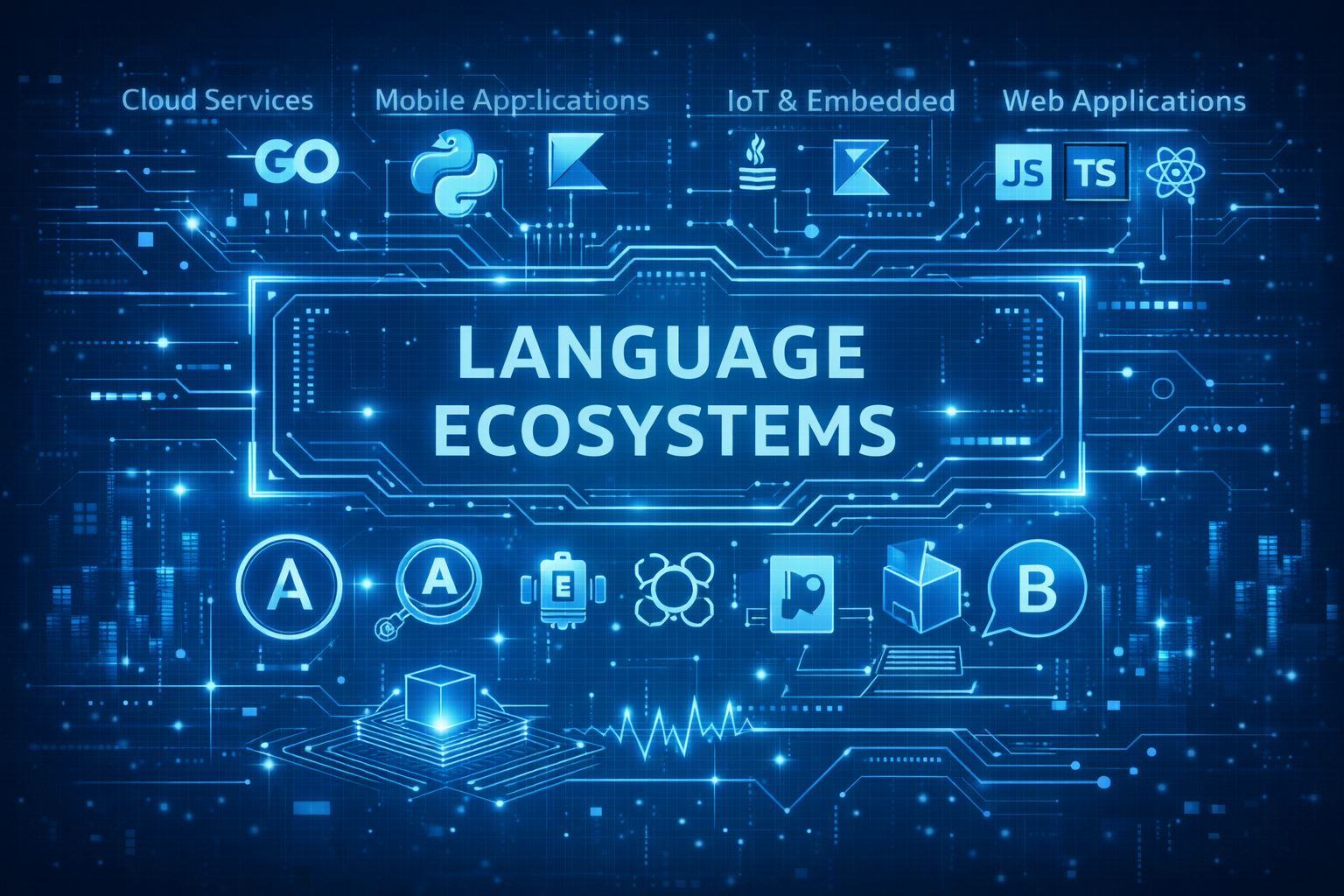
We select languages and frameworks based on runtime characteristics, ecosystem maturity, maintainability, and operational clarity. Each ecosystem is used where it fits best - not where it is merely popular.
Cloud Services: Go & Python
Go
Go is our primary choice for cloud-native backend services that require predictable performance, low memory overhead, and high concurrency. Its static binaries simplify deployment, and its standard library encourages explicit, readable code. Go performs well in distributed systems where reliability and operational transparency are critical.
PythonPython is used when development speed, data processing, or automation workflows dominate. Its ecosystem excels in scripting, integration layers, and data-driven systems. Where appropriate, Python complements Go in hybrid architectures — rapid exploration first, optimized services later.
Mobile Applications: Java & Kotlin
Kotlin
Kotlin is preferred for modern Android development due to its concise syntax, null-safety, and interoperability with Java. It improves maintainability and reduces common runtime errors.
JavaJava remains still today relevant for legacy integration, long-lived enterprise environments, and interoperability scenarios. We use it where ecosystem stability and backward compatibility are required.
IoT & Embedded Systems: C / C++
C
C is used where direct hardware interaction, deterministic timing, and minimal abstraction layers are required. It enables tight control over memory and execution paths in constrained environments.
C++C++ is used when we need stronger abstraction mechanisms while retaining near-hardware performance. Modern C++ allows structured architecture in embedded systems without sacrificing determinism.
Infrastructure as Code: Ansible
Ansible
We use Ansible for declarative infrastructure configuration and repeatable deployment workflows. Its agentless architecture reduces operational overhead and simplifies secure automation across environments. Infrastructure definitions are version-controlled to eliminate configuration drift.
Web Applications: JavaScript, TypeScript, React, Bootstrap, Materialize CSS
JavaScript
JavaScript remains the foundational runtime of the web. We use it where direct browser interaction and lightweight scripting are sufficient.
TypeScriptTypeScript adds static typing to JavaScript, reducing runtime errors and improving maintainability in larger codebases. It is preferred for complex frontend systems where long-term scalability matters.
ReactReact is used for building modular, component-driven user interfaces. Its ecosystem supports scalable frontend architectures and predictable state management patterns.
Bootstrap & Materialize CSSWe use structured CSS frameworks where rapid UI development and consistent design systems are required. These frameworks allow predictable layout behavior while maintaining performance and responsiveness.
It is worth mentioning that frameworks are tools, not dependencies:
UI frameworks are selected based on project scope and lifecycle requirements rather than brand preference.
3D Modeling & Mechanical Design: FreeCAD
FreeCAD
FreeCAD is used for parametric 3D modeling and mechanical design workflows. Its open architecture supports custom workflows, reproducible design iterations, and integration with engineering processes.